Industrial Synthetic Routes to C4F6, Hexafluoro-1,3-butadiene
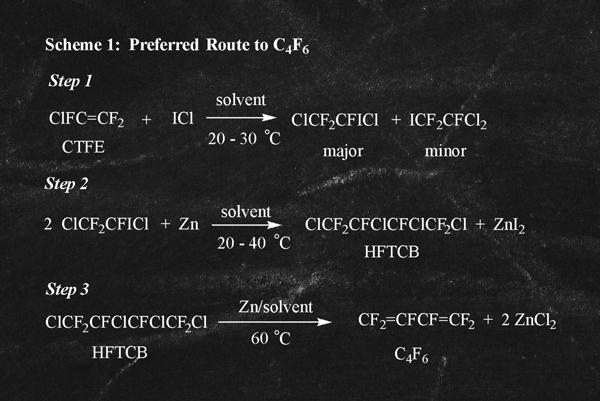
A preferred route to C4F6 involves the readily available raw materials ICl and CTFE in a 3-step synthetic process as illustrated below in Scheme 1. The basis of this chemistry has been known for nearly 70 years and was described in the past scientific literature by several workers including Hazeldine (J. Chem. Soc (1952) 4423), Hauptschein (JACS (1961) 83, 2495), and Ameduri (J. Fluorine Chem. (1995) 74, 261). Moreover, similar process chemistry is described in the Russian Patents, RU 2246477 and RU 2272017.
Step 1 involves the 1,2 additions of the interhalogen ICl to CTFE and results in formation of the major and a minor 1,2-addition products. In step 2, reductive coupling with zinc of the 1,2-addition products provides the perhalogenated butane, HFTCB. In the third process step, HFTCB is reductively dechlorinated with zinc in a polar solvent to provide high purity C4F6. Purification of the final product often is facile owing to the large differences in volatility and polarity of C4F6 compared to the major contaminants such as organic solvent.




.png)
.jpg)